
Content editor onboarding SGEN
⏱ 60-second answer below · full page ≈ 8 min · skim the bold lead-ins to move faster.
The 60-second answer. As a Content Editor on SGEN, your work lives in four areas of the admin: Blog, Pages, Media Library, and Discussions. You write, draft, publish, and moderate — with full creative control over content and no access to settings, users, or theme controls (intentional). Each morning: check the Draft queue, clear the Discussions Pending tab, and publish or polish. Each week: rename unnamed media files and audit revision history. Each month: clear Trash, clean up categories and tags. That's the whole loop. Read on for the step-by-step.
On this page: Your surfaces · Daily steps · Weekly and monthly cadence · Troubleshooting · Other roles
How to hit the ground running as a Content Editor
Your job lives across four areas of the SGEN admin: Pages, Blog, Media Library, and Discussions. This guide covers your first day, your daily routine, and the weekly and monthly hygiene that keeps the site healthy.
You will not need — and do not have access to — settings panels, user management, or theme controls. If something is missing from your left navigation, that is intentional. Ask your site admin if you believe something is wrong.
What is this for?
Your orientation as a new Content Editor on SGEN. By the end you will know where each surface lives, how drafts and published content relate, what your daily rhythm looks like, and the handful of things that catch new editors off guard.
The Editor role sits one step below Admin:
- Can: create, edit, and publish pages and posts; upload media; moderate comments; reply to readers as the brand.
- Cannot: change the theme, edit site settings, manage users, or permanently delete content without moving it to Trash first.
These limits are intentional — they protect the site from accidental configuration changes while giving you full creative control over content.
Good use cases
Example 1: Day one — confirm your surfaces and scan the queue.
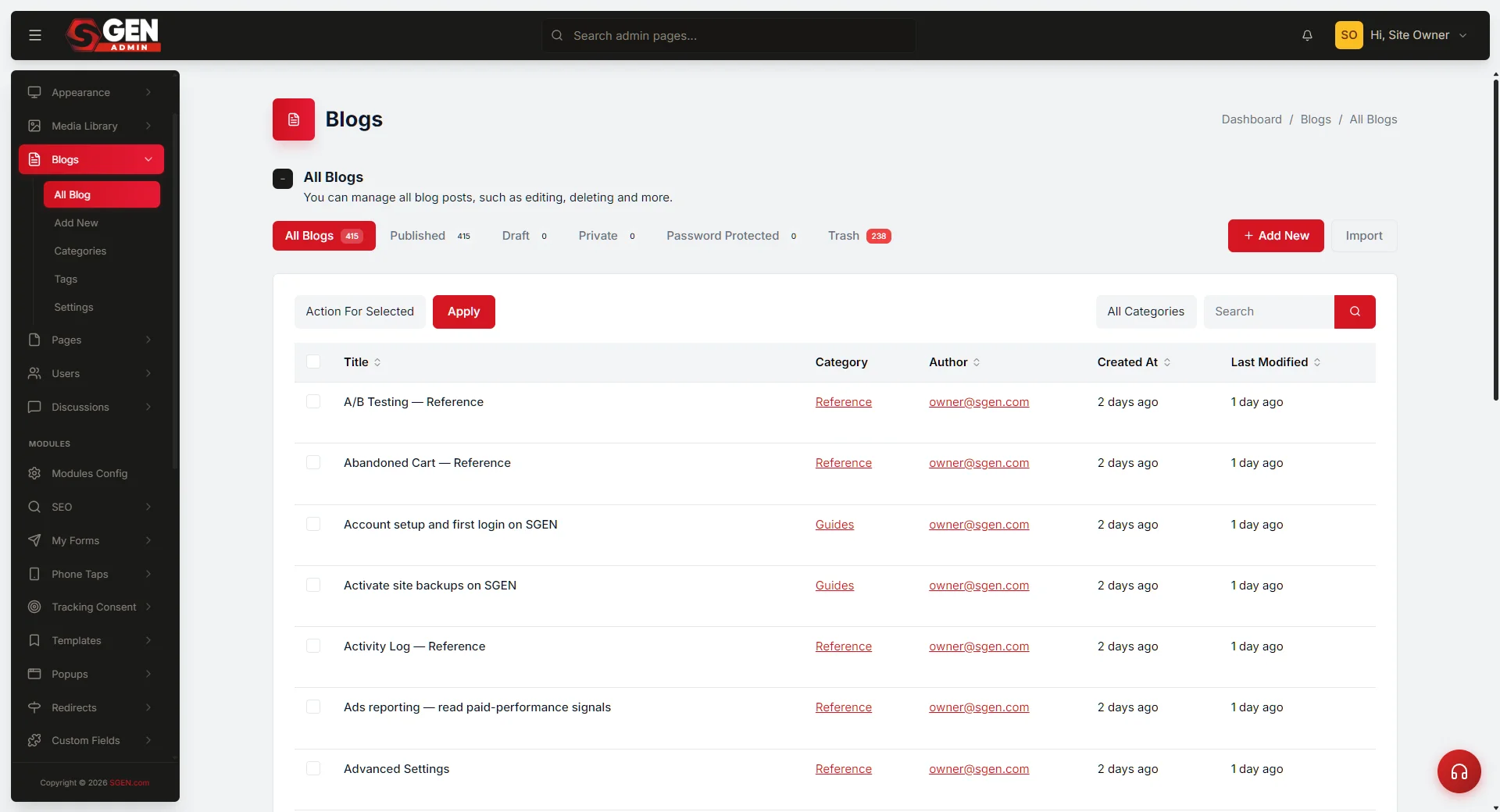
You log in as a new Editor. Check the left navigation: Blog, Pages, Media Library, and Discussions should all be present. Settings, Users, and Appearance are not visible — correct for the Editor role. Open Blog, click the Draft tab, see the posts waiting. Open one, read it, save without publishing. Draft count is unchanged. No harm done.
Example 2: Write and publish a new blog post.
Open Blog → Add New Post. Enter a title, write the body, pick a category, add tags one at a time, and upload a hero image via the in-editor media picker. Click Save as Draft — the row appears in the Draft tab. Preview once, make any copy changes, then click Publish. The post moves to the Published tab and is live at its public URL within seconds.
Example 3: Restore a page revision after a bad edit.
You edited the "About" page and accidentally deleted a paragraph. Open Pages, click the row's View History link, see the revisions listed newest-first, click Preview on yesterday's version, confirm the missing paragraph is there, click Restore, and confirm the modal. SGEN saves the current (bad) version as a new revision before swapping — making the restore itself reversible. Full round trip: under 30 seconds. The same flow applies to blog posts — see pages and blogs.
What NOT to use this for
- Changing the theme or global design — Appearance is outside the Editor role. Raise design changes with your site admin.
- Adding or removing users — Users area is Admin-only. New team members need their account created by the admin.
- Changing site settings — Email routing, cookie consent, payment config are not Editor concerns. Settings panels are not visible to your role.
- Deleting media other posts use — There is no built-in usage check. Deleting an in-use image produces a broken placeholder on the public site immediately. Confirm no live content references it first.
- Publishing without a second read — The Editor role publishes directly with no mandatory approval step. If your content needs sign-off, save as Draft and share the Preview link with your reviewer before clicking Publish.
How this connects to other features
- Pages — Evergreen pages (About, Contact) live here. Edit flow, draft/publish toggle, and page hierarchy you will use every week. Also covers the 10-revision history and restore flow.
- Blog posts — Your primary editorial surface. Drafts, publishing, categories, tags, featured images, post settings, and the same 10-revision safety net.
- Media Library — Every image you add to a post or page flows through here. Upload once, use anywhere.
- Discussions — Daily moderation queue. Approve real comments, mark spam, trash junk, reply to readers as the brand.
Before you start
- Your site admin has created your account and assigned the Editor role. You will receive a login link by email from SGEN.
- You are signing in at your site's SGEN admin URL. Your admin will share the exact address on your first day.
- The left navigation is visible and shows Blog, Pages, Media Library, and Discussions. If any of these are missing, contact your site admin — your role may not be fully configured.
- You have a modern browser (Chrome, Firefox, or Edge) and a stable internet connection.
Where to go
The four areas you will use as a Content Editor, and where they live in the left navigation:
| Area | Left nav path | What you do there |
|---|---|---|
| Blog | Blog | Write posts, save drafts, publish, review revision history |
| Pages | Pages | Edit evergreen pages — About, Contact, Buying Guide |
| Media Library | Media Library �� All Media Files | Upload images, copy asset URLs for use in posts |
| Discussions | Discussions → All Discussions | Approve comments, mark spam, reply to readers |
You will not see Settings, Users, or Appearance in the left nav — those are Admin-only areas. If you need something from those areas, ask your site admin.
Steps
1. Check the Drafts queue each morning
Open Blog and click the Draft tab. A healthy queue is two to three — enough buffer, nothing going stale. Open each draft, check for copy edits, then either polish-and-publish or leave it with a note for your next session.
Repeat for Pages → Draft. Page drafts are less frequent but should not pile up — a page sitting in Draft for more than a month usually means a decision is overdue: publish it or trash it.
2. Write or edit a post (blog or page)
- Open Blog → Add New Post for a net-new post,
or click Edit on an existing row to revise one.
- Enter your title.
The URL slug auto-generates from the title — you can override it in the Post Settings panel on the right.
- Write the body using the content editor.
Inline formatting (bold, italic, links, headings) lives in the editor toolbar.
- On the right panel, set:
Category (required — pick one from the dropdown), Tags (add one at a time, not in bulk), Featured Image (click to open the media picker and select from the library).
- Click Save as Draft to save without publishing.
Click Publish to make it live immediately.
Drafts are never public. A Draft post does not appear on the blog archive or in search results until you publish it. You can share a Preview link with teammates — that link shows the draft exactly as it would appear live.
The same flow applies to Pages — open Pages → Add New Page or click Edit on an existing row. Pages do not use categories or tags, but they have the same Draft → Published toggle and the same 10-revision history as blog posts.
3. Moderate comments in Discussions and reply to readers
Open Discussions → All Discussions and click the Pending tab. Anything over five pending is worth clearing before the workday fills up.
For each Pending row, choose one of the inline actions:
- Approve — makes the comment publicly visible under the post.
- Spam — hides the comment and flags the sender's email for future filtering.
- Trash — hides the comment; recoverable from the Trash tab if needed.
To reply as the brand: click View, scroll to Reply in thread, type your response, and click Reply. Your reply threads under the original comment on the public post.
When spam arrives in volume — say, 14 promotional comments hit the Pending queue overnight — select all rows on the page using the header checkbox, pick Mark as Spam from the Bulk actions dropdown, and click Apply. Result: Pending drops from 14 to 0, Spam count rises by 14.
Weekly and monthly cadence
Weekly:
- Publish 2-3 posts. Confirm the Published tab count in Blog increased by at least two.
- Rename unnamed media files (
IMG_XXXXpattern) before they accumulate. Accepted types: JPG, PNG, WebP, GIF, PDF, MP4, MOV, AVI, DOC, DOCX. Max upload: 10 MB. SGEN auto-downsizes images wider than 2048 px. SVG is not accepted — export as PNG first. - Audit revision history on pages or posts you edited heavily. The 10-revision cap fills faster than expected when multiple editors are active — see pages and blogs.
Monthly:
- Clear Trash in Blog and Pages. Permanently delete only what you are certain you will never restore. Do not permanently delete posts that have approved public comments — deleting the parent post orphans the comment thread in Discussions permanently.
- Clean up categories (Blog → Categories): scan for misspellings or duplicates, rename or merge as needed. Each category has its own public archive page — a rename changes the public URL, so be careful on high-traffic categories.
- Clean up tags (Blog → Tags): scan for duplicates or typos, clean one tag at a time. Rename them individually and confirm each saves before moving to the next.
- Confirm every published post has a category. Filter Blog by Published, scan the Category column. Posts without a category weaken the public archive pages. Reassign by opening the post, updating the Category selector, and clicking Update — the post stays Published, only its taxonomy changes.
What success looks like
At the end of your first month, a healthy state looks like:
- Blog Published tab shows 8-12 posts live, with 2-3 added since you started.
- Blog Draft tab has 1-3 posts in flight — not empty (pipeline healthy), not overflowing (nothing stuck).
- Discussions Pending tab is at 0 or near-0 each morning after your moderation sweep.
- Media Library has no files named
IMG_XXXX— every file is descriptively named and findable. - No page or post has had its revision window lapse without a review.
What to do if it does not work
You cannot see Blog, Pages, or Media Library in the left navigation. Your account may not have the Editor role assigned or it may be misconfigured. Contact your site admin and ask them to verify your account under Users → your email address. The role field should show Editor.
You clicked Publish but the post is still showing as Draft. A required field is likely missing — most often the Category field. Check the right panel for fields highlighted in red. Fill them in and click Publish again.
You saved a post and the revision count is not increasing. Revisions are only created on Published content. Drafts do not generate revision entries — only saves to a Published page or post produce a new snapshot. For draft-iteration notes, keep them manually in the post body before each save.
You uploaded an image but it is not appearing in the media picker. The picker loads from the library — a successful upload should appear immediately. Try refreshing the editor tab (your draft auto-saves every few minutes). If the image still does not appear, open Media Library → All Media Files directly to confirm it is listed. If it is not there, the upload likely failed silently — try again with a file under 10 MB in JPG, PNG, or WebP format.
You tried to restore a page revision but the Restore button is missing. Restore is only available on Published content. If the item is currently a Draft, publish it first, then open View History — the Restore action will appear on all prior revisions.
A comment you approved is not showing on the public site. Check Discussions → Settings to confirm comments are enabled for the content type. Also confirm the individual post or page has comments turned on in its own settings panel — the per-post override can disable comments even when global settings allow them. If both are on and the comment still does not appear, clear your browser cache and reload the public page.
Other roles on this site
Each role on a SGEN site has its own onboarding guide. Use these links to understand what your teammates own — or to share the right guide with a new team member.
| Role | What they own |
|---|---|
| Marketing Manager | Analytics, lead forms, popups, and the blog calendar |
| Ecommerce Manager | Orders, products, coupons, and fulfillment cadence |
| SEO Specialist | SEO audit grid, redirects, robots.txt, Search Console |
| Developer | Custom CSS, Custom Codes, redirects, SG-Builder Additional CSS |
| Support Agent | Read-only admin lookups, ticket triage, escalation paths |
| Platform Admin | Site provisioning, user management, billing, security cadence |
| Partner / Agency | Multi-client delivery, white-label, reseller billing |