
Create and manage events in SGEN
⏱ ~3 min read · quick answer below · full walkthrough ≈ 8 min · skim the bold step headings to move faster.
In short. The Events area publishes time-bound entries — workshops, classes, tastings, meetups — on the public /my-events archive. Each event has a date range, venue address, body content, optional recurrence, a per-event banner, SEO fields, categories, and a thumbnail. Visitors get an Add to Calendar button (Google, Apple, Outlook, iCal) on every published event — no plugin required. Create one, set recurrence if needed, publish.On this page: What this is for · What Events handles · Before you start · Steps (1–8) · Examples · Troubleshooting · Related reading
How to create, publish, and update events in SGEN
What is this for?
Use Events for content with a start time, a venue, and an audience who needs to add it to their calendar. Events appear on /my-events in auto-sorted Upcoming and Past Events sections. Each event gets its own public URL and an Add to Calendar button (Google, Apple, Outlook, iCal) — no plugin required. Blog posts carry no date-range, address, or recurrence; Pages are evergreen and don't appear on /my-events.
Scope
| Aspect | What Events handles |
|---|---|
| Content surface | Body text via SGEN text editor (not SG-Builder by default) |
| Date format | MM/DD/YYYY HH:MM AM - MM/DD/YYYY HH:MM PM (start to end) |
| Public archive | /my-events — Upcoming / Past sections auto-sort by date |
| Recurrence types | Doesn't repeat / Daily / Weekly / Monthly / Yearly |
| Status options | Publish · Draft · Private · Password Protected |
| Not in scope | RSVP/ticketing, bulk date shifts across a series, archive layout (that's Events Settings) |
What NOT to use this for
- Attendee registration and ticketing — No RSVP or registration form is built in. For signups, create an Ecommerce product or embed a third-party form and link to it from the event's banner CTA.
- Bulk date shifts across a series — The form edits one event at a time. To shift all sessions in a series, recreate the recurrence from the corrected start date or edit each occurrence individually.
- Site-wide archive layout — Banner colors and archive layout live in Events Settings, not on the individual event form. Per-event banner settings affect the single-event page only.
- Non-dated content — If the content has no fixed date, use a Blog Post or a Page. The
/my-eventsarchive sorts by date; undated content will not display correctly.
How this connects to other features
- Events Settings — Site-wide archive configuration: title, slug, layout (list or grid), pagination, and the global Add to Calendar toggle. Individual event details go on the event form; archive-wrapper settings go here.
- SEO — Per-archive SEO fields (title, description, canonical) live in the SEO area under the Events panel. Per-event SEO fields live on the event edit form.
- Media Library — Thumbnails and banner images are selected from the Media Library. Upload images there before attaching them to an event.
- Custom Fields — Custom Field groups assigned to the
eventpost type appear automatically as an extra card on the event form. - Redirects — Changing an event's slug breaks any existing inbound links. Create a redirect from the old slug to the new one in the Redirects area.
Before you start
- Sign in with an account that has the EVENTS module enabled.
- Have the event name, date/times, venue address, and body description ready.
- Images first — if you need a banner or thumbnail, upload to the Media Library before opening the event form. There is no inline uploader on the event form.
- Categories first — if you want to assign a category, create it in Events → Categories before opening the form. The picker searches existing categories only; you cannot create one from inside the event form.
Where to go
- In the left sidebar, click Events.
- To create a new event: click Add New in the top-right of the Events list.
- To edit an existing event: click its title in the list, or hover its row and click the Edit row action.
Steps
Both the create and edit paths render the same Event Manage form at /sg-admin/events/add_new (new) or /sg-admin/events/edit/ (existing). The differences are the submit button label ("Create Event" vs "Update Event") and whether the Permalink field is visible. Work through the steps below in order; sections marked optional can be skipped.
1. Fill in the event basics
Enter the event name in the Event Name field — this becomes the public page title, archive card heading, and link text.
In edit mode, a Permalink field shows the current URL slug (e.g. yourdomain.com/my-events/spring-product-workshop-may-2026). The slug auto-fills on first save; click it to edit. Changing a published slug breaks shared links — add a Redirect from the old slug if that happens. On the create-new form, the Permalink field is absent until after first save.
2. Set the date, time, and address
Click Date & Time to open the date-range picker and select start and end. The picker stores the range in this exact format:
`` MM/DD/YYYY HH:MM AM - MM/DD/YYYY HH:MM PM ``
Example — a morning workshop from 10 am to noon on May 10:
`` 05/10/2026 10:00 AM - 05/10/2026 12:00 PM ``
The separator must be a plain space-hyphen-space ( - ). An em dash or en dash causes the date to display incorrectly on the archive.
Date Display Override — if you need free-text instead (e.g. All day, doors open at 9am), enter it in the field directly below the date picker. That text replaces the formatted date on archive cards and the single-event page. Leave blank to use the formatted date.
Enter the full venue address in Address. It appears on the archive card and single-event page. No map embed is generated automatically — add a map link in the body or banner CTA if needed.
3. Write the body content
The Content section uses SGEN's standard text editor — headings, bold/italic, lists, links, and Media Library images. Write the event description: agenda, speaker list, parking notes, or any other narrative. Events do not use SG-Builder for body content. If you need a richly designed landing page, create a separate Page in SG-Builder and link to it from the event's body or banner CTA.
4. Configure recurrence (optional)
Open the Recurrences card (collapsed by default — click the heading to expand).
Recurrence Type:
- Doesn't repeat — single occurrence (default).
- Daily — every day or every N days.
- Weekly — selected days of the week, every N weeks. Check the day checkboxes and set the interval.
- Monthly — a specific day of the month.
- Yearly — annually on the same date.
End Repeat:
- Never — series continues indefinitely. Use with care; the archive accumulates without a cutoff.
- After N occurrences — stops after N events (e.g. "six Fridays").
- On date — ends on a specific calendar date.
Each occurrence generates a separate card on /my-events. Visitors can add any occurrence to their calendar independently.
5. Add a per-event banner (optional)
Expand the Event Banner card and check Enable Banner. The banner appears at the top of the single-event detail page only — not on archive cards.
Configure:
- Body content — headline and supporting copy.
- CTA buttons — use the Add CTA repeater (label + destination URL per button).
- Colors — text color and background color via the color pickers.
- Background image — separate pickers for desktop and mobile background images.
Leave unchecked if the single-event page doesn't need a hero section.
6. Fill in SEO fields (optional)
Expand the SEO card and fill in per-event SEO data:
- SEO Title — overrides the browser tab title in search results. Leave blank to use the Event Name.
- SEO Description — meta description for search results. Keep under 160 characters.
- SEO Canonical — set only if this event exists at multiple URLs. Leave blank in normal use.
- Search engine visibility — check "Discourage search engines" for internal-only or test events.
7. Assign a category and thumbnail
In the right sidebar:
Categories — type to search and select one or more event categories. Categories appear on archive cards and allow visitors to filter the archive by event type. Create any new categories in Events → Categories before opening this form.
Thumbnail — select an image from the Media Library. Appears on the archive card (not on the single-event page unless you also set a banner background image). Recommended dimensions: 800×600 pixels.
8. Set the status and save
In the right sidebar Status dropdown, choose:
- Publish — immediately visible on
/my-eventsand at its individual URL. Visitors can find it, share it, and add it to their calendars. - Draft — saved but hidden from public views. Only visible to SGEN admins in the admin panel.
Click Create Event (new) or Update Event (existing). You are redirected to the Edit screen, with the event's ID now in the URL.
The complete event form
The form below shows a fully-filled event — the Spring Product Workshop session — with all major fields populated, including recurrence type, SEO fields, and sidebar settings.
What success looks like
After saving, you are redirected to the Edit screen with the event's ID in the URL (e.g. /sg-admin/events/edit/12). To confirm a published event is live:
- Open
/my-eventsin a new incognito window (bypasses admin session cache). - Locate the event in Upcoming (future dates) or Past Events (past dates).
- Click the event card — confirm title, date, address, and body content display correctly.
- Click Add to Calendar to confirm it generates a valid calendar download.
Published events are also reachable at their individual URL (/my-events/event-slug) and indexable by search engines.
Draft events do not appear on the public archive. Preview a draft via the Preview row action on the Events list, which opens an admin-only view without changing the Status.
The public events archive
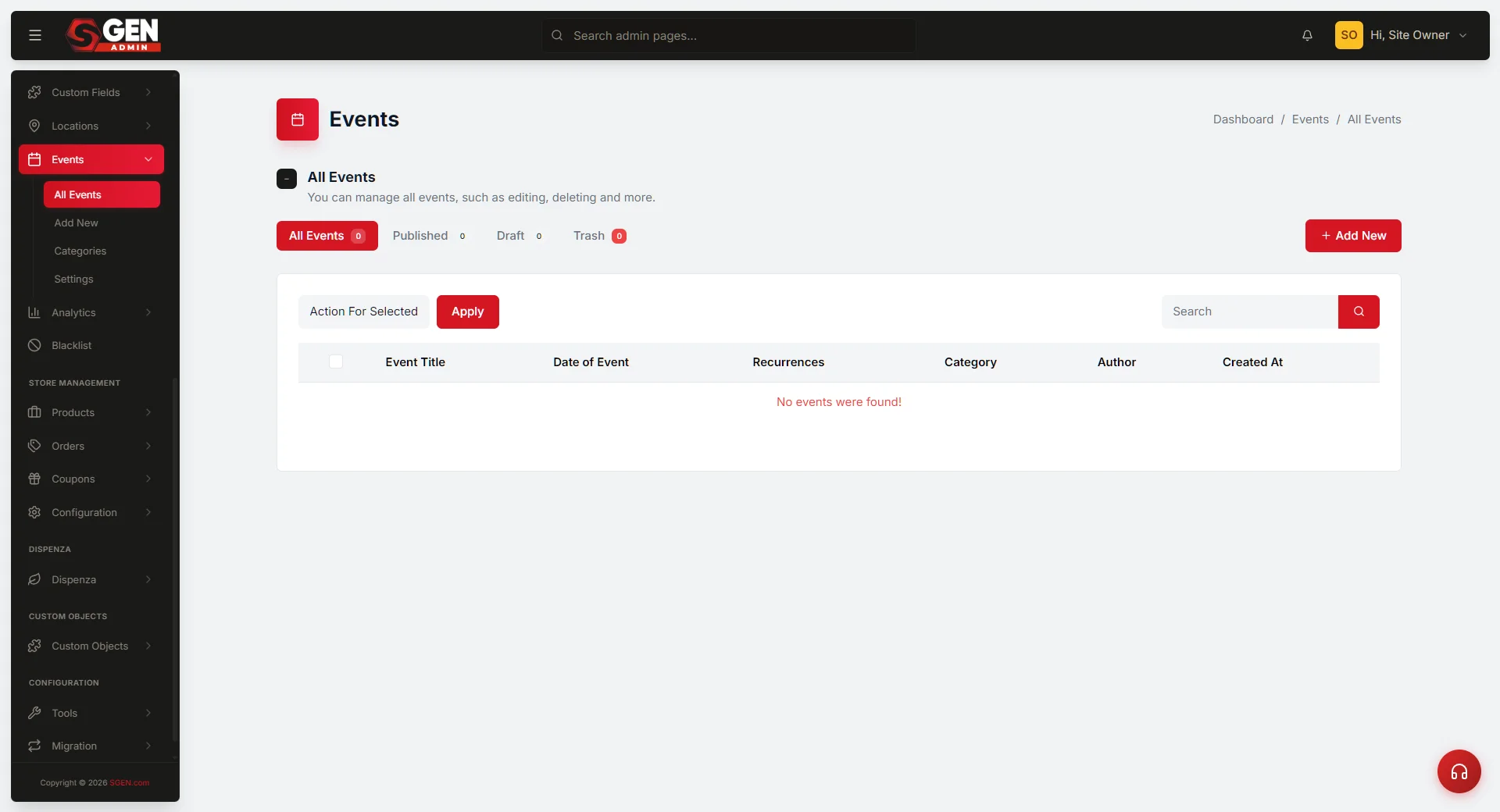
The Events list in the admin shows all events across every status. Tab filters: All Events (everything except Trash) · Published (live) · Draft (hidden from public) · Trash (soft-deleted, recoverable).
,"May 10, 2026 10:00 AM","42 Market St, Portland OR",{"html":"Published"}]},{"cells":[{"html":"Beginner WorkshopEdit|Trash"},"May 2 – Jun 6, 2026 · Weekly","42 Market St, Portland OR",{"html":"Published"}]},{"cells":[{"html":"Hands-on WorkshopEdit|Trash"},"May 16, 2026 2:00 PM","Community Hall, Portland OR",{"html":"Published"}]},{"cells":[{"html":"Spring Product Workshop — May 2026Edit|Trash"},"May 23, 2026 10:00 AM","42 Market St, Portland OR",{"html":"Draft"}]}]}}
Row actions:
- Edit — opens the edit form.
- Preview — admin-only preview in a new tab (Draft events only).
- View — opens the public single-event page (Published events only).
- Trash — soft-deletes: removes from the public archive, moves to the Trash tab. Fully reversible. Restoring from Trash returns the event to Draft status — re-publish to make it live again.
What to do if it does not work
- Event not appearing on
/my-events— Confirm Status is Publish (not Draft). Past-dated events appear in Past Events, not Upcoming. Reload in an incognito window to bypass cache.
- Date displays incorrectly — Verify the Date & Time field matches
MM/DD/YYYY HH:MM AM - MM/DD/YYYY HH:MM PMexactly. The separator must be a plain space-hyphen-space (-). If typed manually, check for an em dash or en dash.
- Date Display Override is showing unexpectedly — Any text in that field replaces the formatted date for that event. Clear it and save to return to the formatted date.
- Thumbnail missing from archive card — Confirm the image was uploaded to the Media Library and then selected via the Thumbnail picker. If the original image was deleted from the Library, re-select a replacement.
- Move to Trash not visible — This action appears in the sidebar only when editing an existing saved event. It is absent on the create-new form.
- Recurrence set but only one session on the archive — Open the Recurrences card and confirm both the recurrence type and at least one day (for Weekly) are set. Check End Repeat — "After 0 occurrences" or an already-past date generates no additional occurrences. Correct and save.
- Add to Calendar button missing — This button is controlled globally in Events Settings. If toggled off there, no individual event shows it. Re-enable in Events Settings.
Vocabulary
| Term | Meaning |
|---|---|
| Event Name | The public-facing title — appears on archive cards, the single-event page, and the browser tab. |
| Date & Time | The start-to-end range stored as MM/DD/YYYY HH:MM AM - MM/DD/YYYY HH:MM PM. |
| Date Display Override | Free-text replacement for the formatted date on public cards. Leave blank to use the formatted date. |
| Recurrence | Weekly / monthly / yearly repeat rule. Each occurrence generates a separate archive card. |
| Add to Calendar | A button on every published event page. Generates a .ics download for Google, Apple, Outlook, or iCal. |
| Trash | Soft-delete: removes the event from the public archive; recoverable via the Trash tab. |
Examples
Example 1 — one-off event. Fill in name, date, address, category, and thumbnail; set Status to Publish; click Create Event. The event appears on /my-events immediately with an Add to Calendar button.
Example 2 — recurring weekly class. Create the event, open Recurrences, set Type to Weekly, check the day(s), set End Repeat to After 6 occurrences. SGEN generates six separate archive cards — one per occurrence.
Example 3 — updating a venue. Open the event's Edit screen, change the Address field, click Update Event. The public page reflects the new address immediately. No redirect needed — the slug did not change.
Related reading
- Create and manage blog posts — no date range, address, or recurrence. Use Blog for news; use Events for anything that needs an Add to Calendar button and Upcoming/Past archive split.
- Create and manage pages — evergreen content (About, Contact, legal). For a richly designed event landing page in SG-Builder, create it as a Page and link to it from the event's banner CTA.
Next step
Configure how the events archive displays to visitors in Events Settings — control the archive title and URL slug, the layout (list or grid), pagination count per page, category filter visibility, and the global Add to Calendar button. Events Settings is where you control the archive wrapper; the individual event form is where you control the content inside each card.
Event recurrence and status options
| Setting | Available values |
|---|---|
| Recurrence | Doesn't repeat / Daily / Weekly / Monthly / Yearly |
| Status | Publish / Draft / Private / Password Protected |