
URL Slug Strategy
Every page and post on your SGEN site has a URL slug — the readable segment after the category prefix. A good slug is lowercase, hyphenated, three to five words, and set once. Get it right at publish time and it stops mattering; get it wrong and you collect broken links, split SEO authority, and redirect debt. This guide covers the rules, the patterns by content type, a migration playbook, and a team convention template you can drop into your editorial style guide.
Set it right at publish
Slugs are infrastructure. A slug changed after publish requires a redirect, breaks external links, and splits SEO authority across old and new URLs. Review the auto-generated slug before you hit publish — every time.
Three to five words, no extras
Drop stop words (the, a, an, is, of), dates, and trailing filler like "post" or "page." The slug carries the topic — nothing else. Short slugs fit in search results, look clean in browser address bars, and are easier to share.
Redirect before rename
If a slug must change, set up a 301 redirect from old to new in Operations → Manage Redirects before changing the slug on the page. There should never be a window where neither slug resolves.
What a slug does
The slug is the trailing portion of the page URL after the category prefix. /care-guide-2026 is the slug. /blog/highlights/care-guide-2026 has care-guide-2026 as the slug under the Highlights category. Slugs do four jobs: they tell search engines what the page is about (keyword signal), tell readers what to expect (URL hover preview, search results), anchor every external backlink, and anchor every internal link. Changing a slug after publish breaks all of those anchors unless a redirect is already in place.
The rules
Eight rules cover the full slug convention. Apply all eight at publish time and no slug will need attention again.
Format
Lowercase and hyphenated
Use /care-guide-2026 — not /Care-Guide-2026 and not /care_guide_2026. Some servers are case-sensitive. Search engines treat hyphens as word separators; underscores collapse the whole segment into one keyword. Your Store uses /canvas-tote-bag, not /Canvas_Tote_Bag.
Length
Three to five words, 60 characters or fewer
A post titled "Introducing our Care Guide 2026 — everything about washing and storing knitwear" gets slug /care-guide-2026, not /introducing-our-care-guide-2026-everything-about-washing-and-storing-knitwear. Short slugs fit in search results without truncation and are easier to share.
Keywords
Match the primary keyword
The slug carries SEO signal and human signal. A post titled "Sandbox tier — try SGEN with a real working site" gets slug /sandbox-tier. Not /post-12489 or /announcement-1. The reader should be able to guess the page topic from the URL alone.
Stability
Set once — redirect before rename
A slug set on day one stays that slug. Legitimate rename reasons: the product or concept name changed company-wide; a major SEO improvement in the primary keyword; cleaning up a typo live for under 24 hours. Cosmetic preferences are not legitimate rename reasons. Every rename requires a 301 redirect in place first.
Stop words
Strip the, a, an, is, of, for, to
Use /care-guide, not /all-about-the-care-guide. Stop words add URL length without adding keyword value. Strip them from the slug even when they appear in the page title.
Dates
Date belongs in metadata, not the slug
Use /care-guide-2026, not /2026-04-20-care-guide. Date prefixes make URLs look stale even when the content is current. The post date belongs in the date field. If you need date-based browsing, use a separate URL pattern like /blog/2026/ — not baked into individual slugs.
Filler
No trailing "post" or "page"
Use /care-guide, not /care-guide-post. The URL is obviously a page — the word "page" adds nothing. Redundant trailing words inflate length and add no keyword or human signal.
Nesting
One category prefix — no deep paths
Use /care-guide under a blog category, not /products/saas/tools/care-guide. Deep paths look complicated, are harder to remember, and signal a confused information architecture. One category prefix is fine; three is too many.
Slug patterns by content type
Consistent patterns help readers and search engines understand site structure at a glance. Use the pattern for the content type — do not mix formats across the same type.
Blog post — topic, 2–4 words, hyphenated
Example: /care-guide-2026 · /wool-beanie-fit
Guide or how-to — action verb + topic
Example: /store-handmade-goods · /connect-your-domain · /wash-wool-knits
Product page — product name, lowercase
Example: /canvas-tote-bag · /leather-card-holder
Reference page — feature or concept name
Example: /forms-module · /media-library
Changelog entry — topic (date in metadata only)
Example: /audit-log-filter-export · /sandbox-tier-launch
Legal page — document name
Example: /privacy-policy · /terms-of-service
Language-prefixed page — ISO code + topic
Example: /en/about · /es/about. Same slug rules apply within each language prefix.
Vertical or role page — vertical or role name
Example: /cafe-owners · /restaurant · /for-designers
Where to find the slug field
Three places in SGEN admin control slug-related settings. Know all three before publishing or renaming any content.
Blog
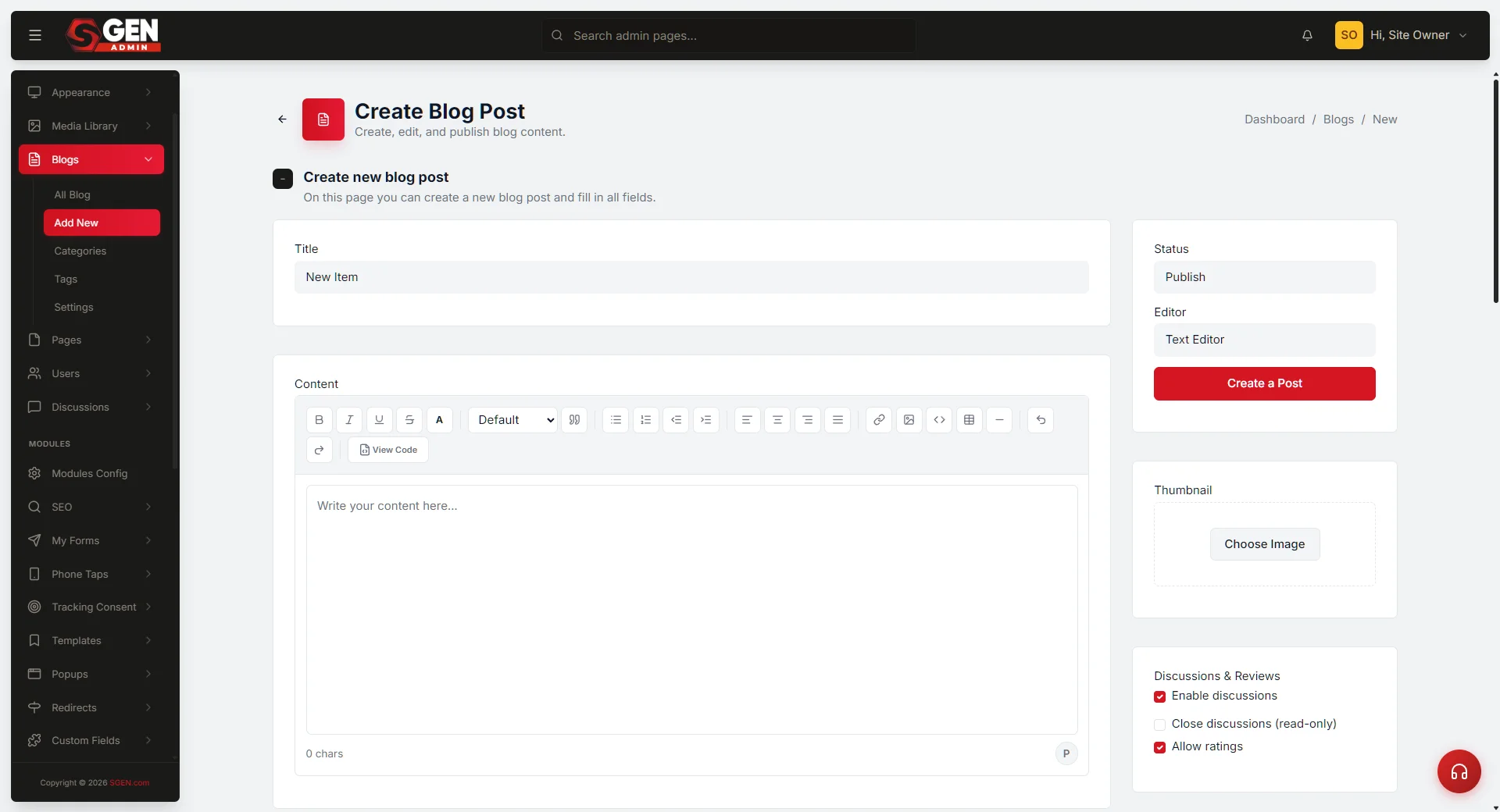
Blog post URL Slug field
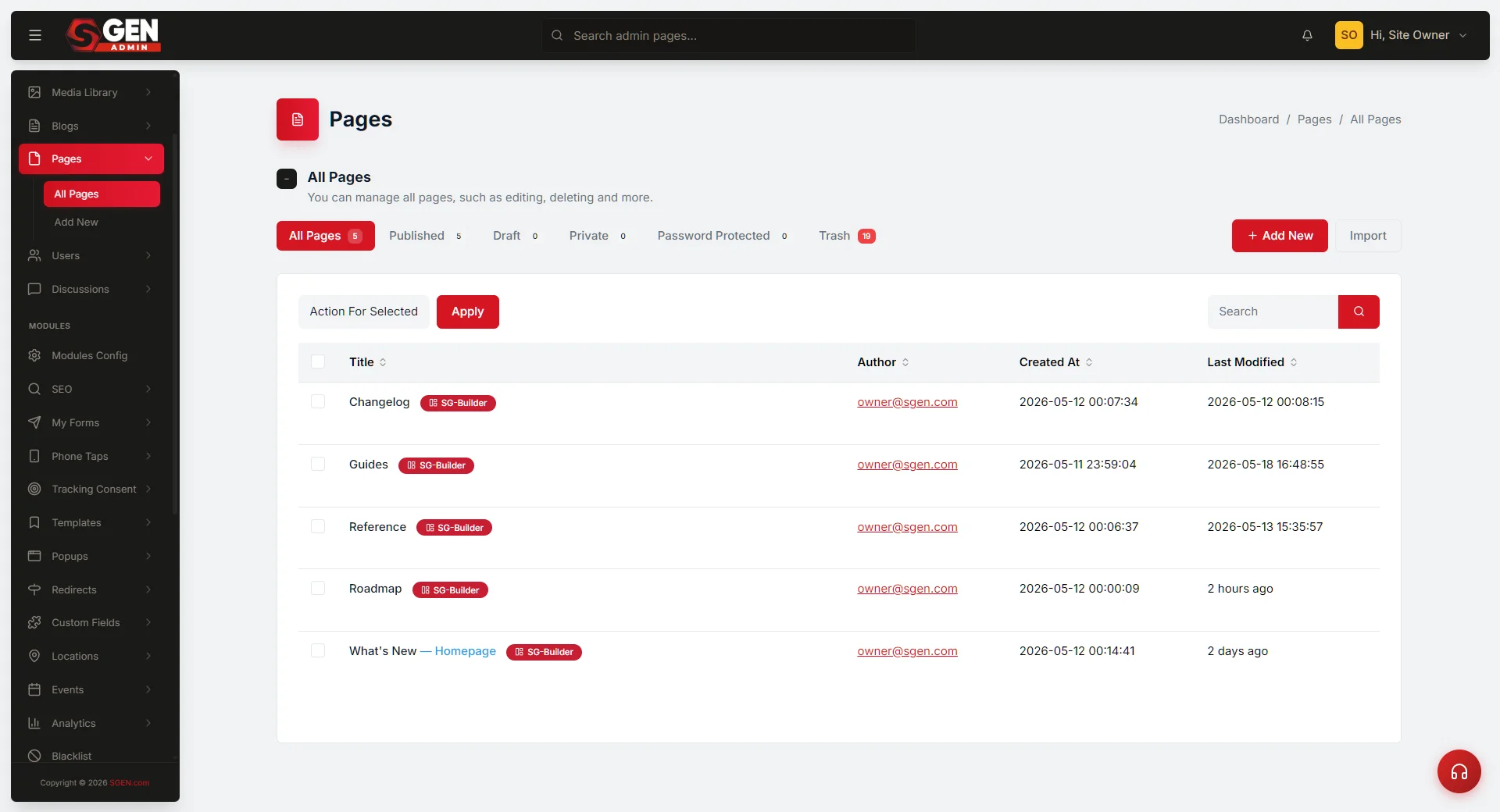
Blog post editor → URL Slug field. Auto-generated from the title when you first save; edit it before publishing. Navigation: Blog → Add New (or select existing post) → URL Slug field.
Pages
Page settings URL Slug field
Pages → select page → Page Settings → URL Slug. The same auto-generate-then-edit pattern applies. Review before publishing any new page.
Redirects
Operations → Manage Redirects
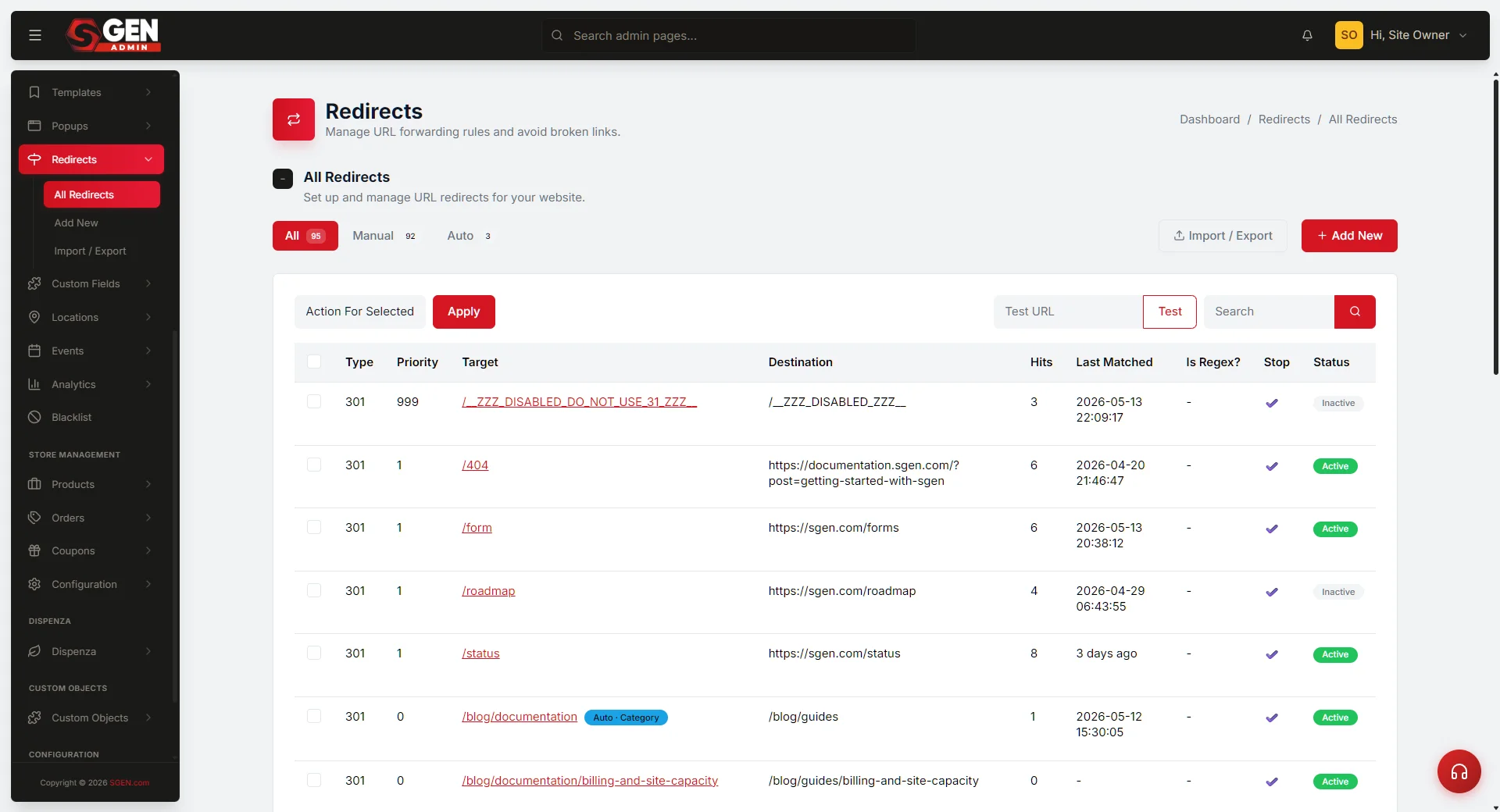
Where 301 redirects are set for renamed slugs. Open this before changing any slug that has already been published. Set the redirect from old slug to new slug first — then change the slug on the page.
Access
Admin navigation path
Pages → select page → Page Settings → URL Slug. For redirects: Operations → Manage Redirects. For blog slugs: Blog → select post → URL Slug field.
Anti-patterns to avoid
Four patterns show up repeatedly on sites with slug problems. Recognising them early saves redirect work later.
Trusting the auto-generated slug without review
The auto-generator lowercases and strips spaces — a start, but it does not strip stop words, shorten verbose titles, or catch typos. Always review the generated slug before publish. Your Store's post "Introducing our new spring knitwear care guide for 2026" auto-generates as /introducing-our-new-spring-knitwear-care-guide-for-2026. The right slug is /care-guide-2026.
Planning to rename slugs for SEO later
Renaming after publish requires redirects, breaks external links, and splits SEO authority between old and new slugs. Get it right at publish time. "I'll fix it later" is how sites accumulate redirect chains.
Putting dates in slugs to make browsing easier
Use the admin sort and filter by date — not the URL — for internal navigation. Dates in URLs look stale to readers. /2026-04-20-care-guide looks archived before it is.
Keeping messy imported slugs "for SEO continuity"
If the imported slugs were good — fine, keep them. If they are /?p=2489 style or /2024/04/the-new-care-guide/ — set up redirects from old to new, accept the short-term SEO hit, and win long-term with cleaner URLs. The redirects carry authority forward.
Migration playbook
If you are migrating from a site with messy slugs — date-prefixed, numeric IDs, stop-word-heavy — follow these steps in order. Do not skip the redirect step. Example: Your Store imported 147 posts from WordPress. 62 had acceptable slugs (kept). 48 had date prefixes (removed date, kept topic). 37 had numeric WordPress IDs (renamed to topic-based slugs). 147 redirects set up. Thirty-day monitoring: zero missed redirects.
1
Inventory current slugs
Export the full list of slugs from your old CMS. Flag obvious bad patterns: date-prefixed, numeric IDs, stop-word-heavy, too long. You need the full list before deciding what to keep.
2
Decide what to keep, rename, or merge
Do not rename everything — only the worst offenders. Keep slugs that are already short, descriptive, and hyphenated. Rename slugs that are date-prefixed, auto-generated IDs, very long, or keyword-empty.
3
Map old to new
Create a spreadsheet: current slug, new slug, redirect type (301). This is your redirect manifest. Every row in this spreadsheet becomes a redirect entry in SGEN.
4
Set up 301 redirects before changing slugs
Go to Operations → Manage Redirects. For every renamed slug, add a 301 from old slug to new slug. Do this BEFORE changing the slug on the page — there should never be a window where neither slug resolves.
5
Update internal links
Search and replace across your content for old slugs pointing to new slugs. Internal links that still point to old slugs will get redirected, but clean internal links are better than redirect chains in your own content.
6
Submit the updated sitemap
Submit to Google Search Console to signal the new URL structure. The updated sitemap tells search engines which slugs are canonical and triggers re-crawl of the renamed URLs.
7
Monitor for 404 spikes for 30 days
Watch Search Console for 30 days post-migration. Any 404 spike means a redirect is missing. Add the missing redirect via Operations → Manage Redirects as soon as it shows up.
Slug quality scoring
Use this nine-point rubric to assess any existing slug. A slug that passes all nine checks is a good slug. Anything failing three or more checks should be renamed — with a redirect in place first.
Lowercase — pass: /care-guide-2026 · fail: /Care-Guide-2026
Case inconsistency causes 404s on case-sensitive servers and looks unprofessional in hover previews.
Hyphenated — pass: /care-guide · fail: /care_guide
Underscores collapse the segment into one keyword for search engines.
Short (60 chars or fewer) — pass: /care-guide-2026 · fail: /announcing-our-brand-new-care-guide-for-the-year-2026
Long slugs truncate in search results and are harder to share.
Descriptive — pass: /care-guide-2026 · fail: /post-12489
Reader and search engine should both know what the page is about from the slug alone.
No date prefix — pass: /care-guide-2026 · fail: /2026-04-20-care-guide
Date prefixes make content look stale and do not auto-update when content is refreshed.
No stop words — pass: /care-guide · fail: /all-about-the-care-guide
Stop words inflate length without adding keyword or human signal.
No trailing filler — pass: /care-guide · fail: /care-guide-post
Words like "post" and "page" are redundant — the URL is obviously a page.
Minimal nesting — pass: /blog/care-guide · fail: /blog/guides/techniques/advanced/care-guide
Deep paths are harder to remember and signal confused information architecture.
Stable since publish — pass: same slug since day one · fail: renamed without redirect
Renamed slugs without redirects create 404s for every external and internal link pointing to the old path.
Team convention template
Copy this block into your editorial style guide. Every person who publishes content should read it before their first publish. Fill in the site name and adjust the examples to match your actual content types.
## URL slug convention — [Your Site Name]
All pages and posts follow this convention:
- Lowercase, hyphenated, no stop words, no dates, 60 characters or fewer
- Blog posts: 2–4 words describing the topic (/care-guide-2026)
- Product pages: product name (/canvas-tote-bag)
- Guide pages: action verb + topic (/store-handmade-goods)
- Legal pages: document name (/privacy-policy)
Before publish: review the auto-generated slug.
Edit if it is over 60 chars, date-prefixed, or stop-word-heavy.
After rename: always set a 301 redirect from the old slug
before changing the page slug.
Heads up Slugs are sticky. Breaking SEO authority by changing every old slug retroactively is worse than ugly URLs. Apply the convention going forward; only retro-fix the worst offenders. In one audit, 38 of 147 blog post slugs failed two or more checks — the team renamed the 12 worst immediately and scheduled the remaining 26 over the next quarter.
What to do next
Slug rules (apply all eight at publish time)
| Aspect | Rule | Do / Don't |
|---|---|---|
| Format | Lowercase and hyphenated | /care-guide-2026 not /Care-Guide-2026 or /care_guide_2026 |
| Length | Three to five words, 60 characters or fewer | /care-guide-2026 not /introducing-our-care-guide-2026-everything-about-washing-and-storing-knitwear |
| Keywords | Match the primary keyword | /sandbox-tier not /post-12489 or /announcement-1 |
| Stability | Set once - redirect before rename | Every rename requires a 301 redirect in place first |
| Stop words | Strip the, a, an, is, of, for, to | /care-guide not /all-about-the-care-guide |
| Dates | Date belongs in metadata, not the slug | /care-guide-2026 not /2026-04-20-care-guide |
| Filler | No trailing 'post' or 'page' | /care-guide not /care-guide-post |
| Nesting | One category prefix - no deep paths | /care-guide not /products/saas/tools/care-guide |