
Cross-site template sharing in SGEN
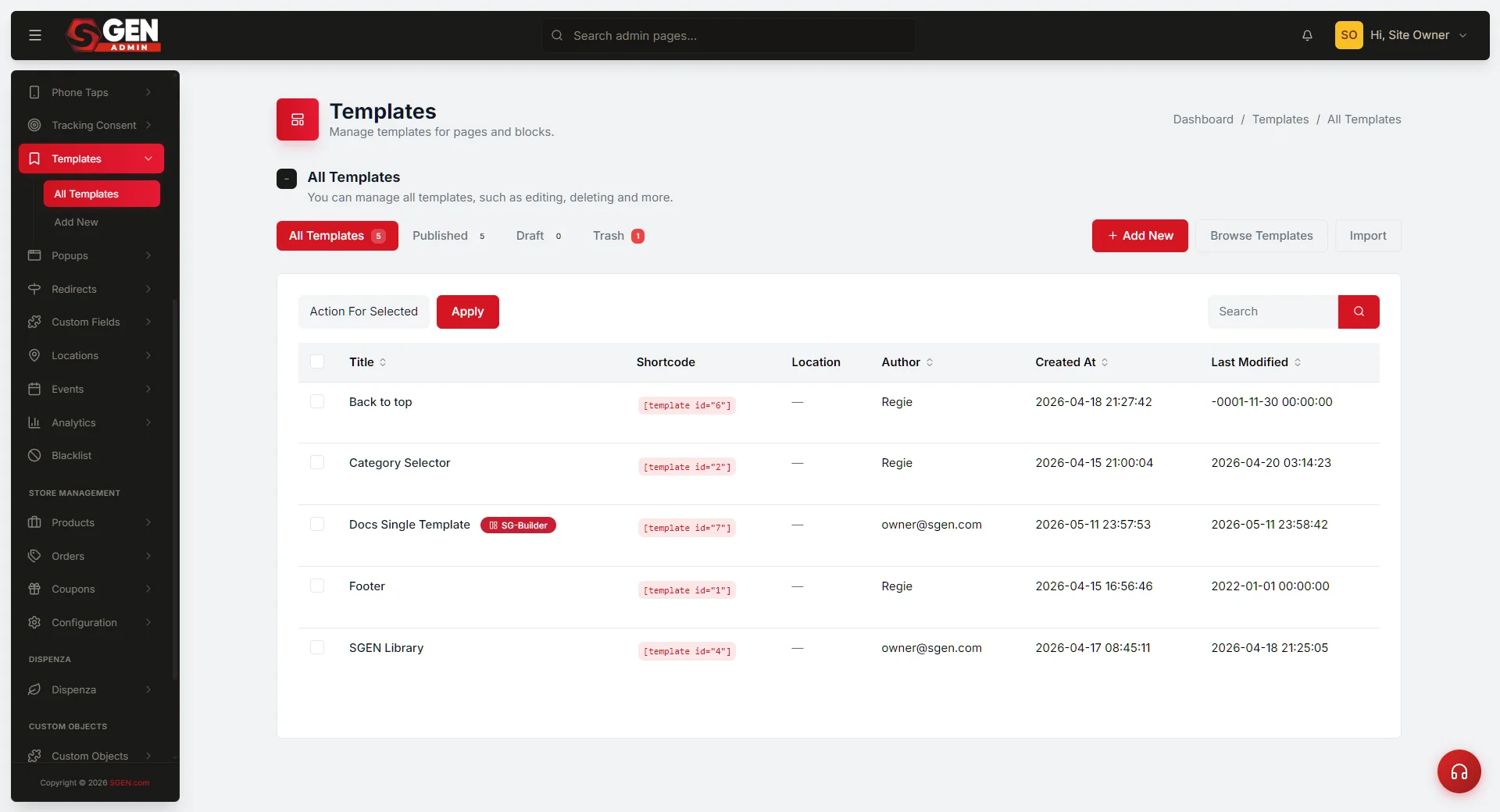 Templates > Custom Templates) showing the per-template Export action and the Import button" loading="lazy" style="width:100%;max-width:900px;height:auto;border-radius:8px;border:1px solid #e5e7eb;display:block;margin:12px 0">
⏱ Quick answer below · full page ≈ 14 min · skim the bold lead-ins to move faster.
In short. SGEN gives you three ways to share design across multiple sites: clone-on-create (copy a full site once at provisioning), template export and import (share individual reusable blocks between sites), and manual design system replication (enter the same theme values on each site). There is no live two-way sync — all three methods are explicit, one-time copies.
On this page: Good use cases · What NOT to use this for · How this connects · Before you start · Where to go
How to reuse design system, templates, and media across your portfolio
Each SGEN site is isolated by default — its own theme, media library, and templates, so a change on one site never leaks into another. When you want consistent design across sites, pick one of three mechanisms:
| Mechanism | Effort | Best for |
|---|---|---|
| Clone-on-create | Lowest | Fast start; sites evolve independently after |
| Template export and import | Medium | Sharing specific page patterns or components |
| Manual design system replication | Highest | Brand tokens only (colour, type, spacing) |
No mechanism provides live two-way sync. All three are deliberate, one-time copies.
Good use cases
| Goal | Mechanism |
|---|---|
| Brand portfolio sharing typography + colour | Manual replication — enter theme values on each site |
| Agency reusing a house header-footer | Export from house-style site, import per client, customize |
| Sister site for retail expansion | Clone-on-create; wholesale site evolves from day one |
| Regional split with localized content | Clone from source region, swap copy and contacts |
| Campaign microsite from brand starter | Clone from a "campaign starter" site |
| B2B and D2C stores from the same brand | Manual theme replication; checkout and catalog differ per site |
| Multi-location chain with shared chrome | Clone-on-create plus per-location menu customization |
What NOT to use this for
- A live design-system pipeline. SGEN does not push design changes from one site to another automatically. If you change a colour on the source site, the cloned sites do not update. Use external design tooling (Figma, brand kits) as the single source of truth and propagate manually.
- Real-time content syndication. Templates are structural — they do not carry live content between sites. If you want one blog post to appear on two sites, you publish twice, not once.
- Cross-site media sharing in the strictest sense. Each site has its own media library. The Template export/import does carry referenced media files, but it does so as copies — once imported, the media on the destination site is a new asset, not a shared one.
- Forms shared across sites. Form definitions can be templated, but form submissions stay scoped to the site they were submitted on. There is no cross-site form-submission pool.
- Per-page sync. Cloning copies pages at create time only. Editing a page on the source site does not edit the same page on the cloned site.
- Workspaces with cross-site shared drafts. Drafts live in the site they were created in. No cross-site draft sharing.
- Cross-site users or memberships. Customer accounts (sign-up logins on the public site) are scoped per site. A user account on site A does not log in on site B.
- Cross-site search. Each site has its own search index. There is no portfolio-wide search.
How this connects to other features
- Add a second site. The clone-on-create option is the cleanest moment to copy a full design. The other two mechanisms (template export and manual replication) can be used at any time on existing sites.
- Theme Editor. Manual design system replication relies on the Theme Editor to enter and verify values. Every site has its own Theme Editor instance.
- Templates library. The platform's built-in templates show on every site. Your custom-saved templates are per-site by default and require explicit export to share with another site.
- Media library. Per-site. Template imports that reference media files copy those files into the destination site's library.
- Custom CSS and Custom Codes. Per-site. Copying a Custom CSS snippet from one site to another is a copy-paste action in the admin.
- Site backup and restore. Restoring a backup on site B does not migrate B to look like A. Backups are scoped per site.
- Per-site analytics. Sharing design does not share analytics. Each site reports its own visitors, sessions, and conversions.
- Account audit log. Template export and import actions show in your account audit log alongside other admin actions.
Before you start
Pick the mechanism before provisioning — switching later usually means redoing the work.
- One-time copy, sites evolve freely after → clone-on-create.
- Specific component or page pattern → template export and import (header-footer, hero, pricing).
- Brand tokens only, layouts differ per site → manual design system replication.
- Stricter brand integrity → pair any mechanism with an external brand kit document; the kit is the source of truth, each site's Theme Editor reads from it.
Three questions that narrow the choice quickly: Do you need automatic propagation? (No mechanism does this.) Do all pages need to match, or just the brand tokens? How often does the design change after launch?
Where to go
The three mechanisms each have their own location in the admin.
- Clone-on-create. Only available at site provisioning. SG-Dashboard → Sites → + Add New → Starter content → Clone from existing site.
- Template export. Inside any site. Site → Templates → Custom Templates → [select template] → Export.
- Template import. Inside the destination site. Site → Templates ��� Custom Templates → Import.
- Theme Editor (for manual replication). Inside each site. Site → Design → Theme Editor.
The Custom Templates page lists all templates saved on that site. The Export action is per-template; you cannot export multiple templates as a bundle today.
The Theme Editor opens with the current site's design system loaded. Switching sites and reopening Theme Editor loads the new site's values — there is no side-by-side comparison view across sites within the platform.
Steps — Three reuse paths, end-to-end
1. Path A — Clone-on-create
When you add a new site, the simplest reuse path is to pick Clone from existing site as the starter content. The new site provisions as a snapshot of the source.
This option only appears at site creation time. You cannot retroactively clone an existing site into another existing site — the destination site must be brand new.
2. What clone copies
Cloning copies:
- All page templates and the design system (theme values, typography, colour, spacing).
- Custom CSS and Custom Codes snippets, including their on/off states.
- Site settings: SEO defaults, header/footer markup, sitemap settings, robots settings.
- Custom templates saved in the source site's Templates library.
Cloning does not copy:
- Form submissions and submission-inbox state.
- Visitor analytics history.
- Media library files (referenced templates carry placeholders pointing at empty asset slots until you re-upload).
- Per-site role assignments (the cloned site uses the inherited account team unless you scoped it down).
- Live or scheduled posts in the blog — only template-level structure is cloned, not authored content.
The boundary is design and structure (cloned) vs operating-state data (not cloned). This matches what most operators want: a new site that looks like the source, with a blank operating record.
3. Path A finish — Diverge the clone
After cloning, the two sites are independent. Edits on the source do not propagate. Edits on the clone do not affect the source. This is the right model when you want a fast start and individual evolution.
You can verify the clone landed by opening any page in the new site and comparing visually with the source. Layouts, fonts, and colours should match. Content placeholders may show empty image slots where source media was not bundled.
4. Path B — Export a template from the source site
Inside the source site, navigate to Site → Templates → Custom Templates. Pick a template you want to share (a hero block, a pricing section, a full page layout). Click Export.
The export form asks:
- A Template name for the export file.
- Whether to Include media (referenced images).
- Whether to Include global styles (any Custom CSS the template uses).
- The Export format — a single SGEN template file or an HTML + assets folder.
Pick Single file for the common case; the folder format is for advanced users who want to inspect or edit the export before importing.
5. Path B continued — Save the export
Save the export file locally. The file is portable across SGEN accounts (an agency could export from one client account and import to another) but the typical case is moving between sites in the same account.
Storing exports in a shared team folder works well for agencies — the team builds a library of pre-vetted templates and pulls from it on each new client onboarding.
6. Path B continued — Import into the destination site
Open the destination site's admin. Navigate to Site → Templates → Custom Templates → Import. Upload the export file. The platform parses the file, lists what is being imported (template, media, custom CSS), and asks you to confirm.
Click Import. The template appears in the destination site's Custom Templates list. Pages built from the template now render the same way on the destination site as they did on the source site.
If the template referenced media that was bundled in the export, those media files copy into the destination site's media library as new assets. The original media on the source site is untouched.
7. Path B continued — Use the imported template
The imported template is now a regular Custom Template on the destination site. Build a page from it the same way you would any template — pick it from the template picker when creating a new page or section.
Future edits to the template on the destination site only affect the destination site. The source-site version stays as it was at export time. There is no link or sync between the two copies.
8. Path C — Manual design system replication
For brand-level consistency without copying any layout, replicate the design system manually. Open the source site's Theme Editor and write down (or screenshot):
- Primary, secondary, and accent colours with their hex values.
- Typography choices: heading font, body font, weights, line-heights, font scales.
- Spacing scale: base unit, multipliers, section padding, container max-width.
- Component-level defaults: button corner radius, card shadow, link colour, hover treatments.
- Image-handling rules: aspect ratios for hero images, thumbnail sizes, alt-text defaults.
Take screenshots of the Theme Editor's panels as well — they capture the visual context around each value, which helps when you are entering the same values on the destination site weeks later.
9. Path C continued — Enter the same values on the destination site
Open the destination site's Theme Editor. Enter the same values. Save. The destination site's components, type, and colour now match the source.
Future changes are intentional — if the source updates its primary colour, the destination does not change unless you go and update it too. This is the right model when you want explicit brand control and accept the manual effort.
A spreadsheet or brand kit document can act as the canonical source of truth for the values, with each site's Theme Editor entering values from that document. This pattern works well for teams of two or more brand managers across sites.
What success looks like
Reuse has landed correctly when:
- Destination pages match the source for the templates you shared — layouts, fonts, and colours align visually.
- Design tokens match — Theme Editor colour, typography, and spacing on the destination reflect what you copied.
- Custom CSS and Custom Codes on the destination include any snippets the imported template needed.
- The source site is unchanged — reload source admin to confirm nothing moved.
- Copied media is on the destination as its own asset; the source library is untouched.
- The audit log on the destination records the import with timestamp and actor.
For a brand portfolio: every site's homepage is recognizable as the same brand, while the content inside is unique. For an agency: new client sites start from a known house pattern instead of a blank page.
For an operator running localized regional sites: visiting any region's site shows the brand's consistent visual identity. Inside the admin, each region's team works independently on locale-specific content.
What to do if it does not work
- Imported template renders differently than on source. The template likely depends on Custom CSS or Custom Codes that did not export. Check the destination site's Custom CSS and Custom Codes lists and copy any missing snippets manually.
- Cloned site is missing media. Cloning does not copy the media library. Re-upload on the destination, or re-export the template with Include media checked.
- Theme values do not match after copying. Some Theme Editor fields require an explicit Save click. Re-enter and save, then verify.
- Template import fails with a parse error. Re-export from the source. If the second export also fails, contact support with both files.
- Custom font from the source does not appear. Custom fonts are per-site. Upload the font file on the destination via Theme Editor → Custom Fonts → Upload, then enter the same font-family name.
- Import succeeded but template is not visible in page builder. Refresh the admin tab — the Custom Templates list caches briefly.
- Sites slowly drift apart in design. Pair platform reuse with an external brand kit document and a quarterly drift audit across Theme Editor values.
- A brand colour changes globally. Update each site's Theme Editor primary colour. Pages using the theme token update automatically; inline styles and Custom CSS need a separate pass.
- Exported templates from a now-deleted source site. Export files are self-contained — they do not reach back to the source site and remain usable on any destination.
Worked example — Your Store house style across three sites
Your Store's three sites — Coffee, Wine, Bookstore — share typography, primary colour, and spacing.
- Brand kit defined externally first. Two pages in a shared document: Brand Colours and Brand Typography. Each Theme Editor value has a name and use case in the kit.
- Your Store Wine cloned on day one. Pricing-page structure, footer, and header carried over. The Wine team customized the homepage and added a wine grid.
- Your Store Bookstore provisioned fresh with manual theme replication. The Bookstore needed a literary, text-led layout — cloning would have brought coffee-shaped structure. Manual replication preserved the typography and colour while leaving the layout open.
- Quarterly drift audit. One person compares each site's Theme Editor against the brand kit and corrects any drift.
Eighteen months later: all three sites read as the same brand at a glance; each tells a distinct story inside.
Worked example — Agency reuses house header pattern
An agency manages eight client sites with a shared house header pattern (utility bar, logo/nav row, breadcrumb/search row).
- House header built once on the agency's portfolio site. Exported with media and styles into a shared team folder.
- Every new client site imports the house header as the starting point, then customizes logo, phone number, brand colour, and nav items.
- When the agency redesigned the header (simpler two-row layout), it re-exported. New sites use the new version; existing client sites stayed on the old one. Any client who requested the update got a fresh import on their site — old template retired after the swap.
The pattern: central house style, import-and-customize per client, no retroactive pushes without a client conversation.
Notes on what is per-site vs portable
The platform draws a clear line between per-site state and portable design assets. Worth memorizing:
Per-site (not portable):
- Visitor analytics history
- Form submissions
- Customer accounts (public-side sign-ups)
- Comment threads
- Search index
- Backups
- Domains
- Plan tier and billing line items
- Site name
Portable (carryable via clone or export):
- Theme Editor values (colour, typography, spacing)
- Custom templates
- Custom CSS snippets
- Custom Codes snippets
- Site settings (SEO defaults, header/footer markup)
Per-site by default but copyable via template export:
- Media files referenced by templates
- Font files uploaded via Theme Editor
- Inline images embedded in template HTML
Understanding the line removes most of the surprise from reuse work. If something is per-site, no mechanism will share it across sites in real time. If something is portable, you choose when and how to propagate.
Common questions
Can I sync a design system across all sites in real time? No. SGEN does not push design changes between sites. Use an external brand kit as the source of truth and update each site's Theme Editor manually when the kit changes.
Can I share Custom CSS between sites? Not as a live link. Copy-paste the snippet from the source site's Custom CSS editor into a new snippet on the destination site.
Can I share the media library between sites? No live sharing. Template exports with Include media checked copy referenced files into the destination as new assets.
Does cloning a site carry over analytics? No. The cloned site starts with empty analytics history. The source site's analytics are unaffected.
Can I make a "primary" site that others sync to? Not natively. Some teams designate one site as the canonical reference and re-replicate manually on a schedule.
Does Theme Editor have a "copy from another site" action? Not currently. Theme values are entered per site.
Can I export an entire site as a reusable template? Clone-on-create at provisioning does this in one step. There is no full-site export-then-import flow outside of provisioning.
Will updating a template on the source site update imported copies? No. Template export is a one-time copy. The destination's template is independent.
Can I lock a site so its shared design cannot be changed? Not via platform locks. Use per-site role permissions to control who can edit the Theme Editor.
Does template sharing affect site performance? No. Each site renders from its own files. There is no runtime dependency between sites.
Can I bulk-export several templates at once? Not in the current version. Export each template separately.
Is there a version history on imported templates? The imported template is a new entry on the destination site and has its own edit history there. The source version is independent.
Can I share a custom font without a template? Yes — upload the font file on each site via Theme Editor → Custom Fonts → Upload and use the same font-family name.
Does clone-on-create work if the source site is on a higher plan? The clone copies design, not plan tier. The new site starts at the tier you pick. Features requiring the higher tier show as inactive until you upgrade the new site's plan.
Related reading
- Add a second site to your account — the provisioning entry point.
- Multi-site permissions and roles — scope who can change shared design on each site.
- Consolidated reporting across sites — portfolio-wide reporting once reuse is set up.
- Agency client portfolio setup — patterns for agencies reusing a house style.
Cross-site design reuse is a content-strategy choice as much as a tooling choice. Pick the mechanism that matches your consistency target, document the brand source of truth outside the platform, and audit periodically. The next read is multi-site permissions, which covers who can change shared design on each site.